Ticket sales start on 25 November 2025, 10 am CET!
Organ Workshop in Naumburg
Workshop with Prof. Pieter van Dijk (Alkmaar/Amsterdam, NL), Dr. Christine Blanken and Dr. Markus Zepf (Leipzig Bach Archive), Dr. Tomasz Górny (University of Warsaw) and guided tours of the city and of St. Peter and Paul’s Cathedral
Workshop for interested laypeople, part-time organists and students
- Active participation: € 110
(additional enrolment at: orgelworkshop@bach-leipzig.de) – 10 people max.
- Passive participation: € 88
Both include transport
Course languages: English
Start: 9.00 am (from St. Thomas, main entrance), return: approx. 6.00 pm
Active participants have 30 minutes on the instrument to work on one piece Pieter van Dijk. Please let us know which piece you have prepared by writing to orgelworkshop@bach-leipzig.de (contact persons: Christine Blanken and Markus Zepf)
About the programme
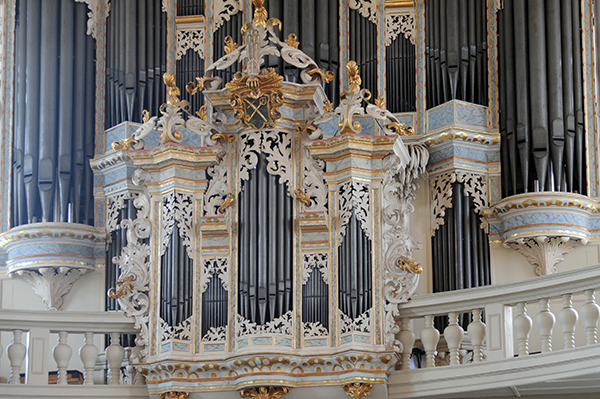
In 1746, after some three years of building, Zacharias Hildebrandt completed the new three-manual organ of St. Wenzel’s Church in Naumburg. It is the largest organ by the »Saxe-Weissenfels Court Organ-builder« and former apprentice to Gottfried Silbermann. In September 1746, the completed instrument was inspected and approved by Silbermann as fellow organ-builder and Johann Sebastian Bach as expert organist and music director of Leipzig.
Although Bach no longer worked as an organist during his time in Leipzig, it was there, from 1723, that some important individual works were composed, including the Preludes and Fugues in B minor, BWV 544, C minor, BWV 546, and E minor, BWV 548, and, later, the works known as the Schübler Chorales, BWV 645–650. The latter are arrangements for organ of arias from the chorale cantatas with a hymn tune as the cantus firmus and which appeared in print in 1747-1748. The highpoint of Bach’s organ compositions in Leipzig is his largest collection for organ, Part III of the Clavier-Übung, which appeared in print in 1739. This includes nine organ chorales based on Martin Luther’s Kyrie and Gloria hymns (»Kyrie, Gott Vater« and »Allein Gott in der Höh sei Ehr«) in pedaliter and manualiter versions. Added to these are chorale arrangements of hymns from the Lutheran Catechism. Here, in a plethora of forms and styles, Bach shows just how much compositional potential chorales offer. Framing the 21 organ chorales is the Prelude and Fugue in E flat major, BWV 552.
The workshop is devoted to selected compositions from the above collections, as well as individual works, performed on Zacharias Hildebrandt’s Naumburg instrument, which is ideally suited to this repertoire.
About the teachers
Prof. Pieter van Dijk
has been Professor of Organ at the Conservatorium van Amsterdam since 1989 and in 1995 was appointed Professor of Organ, Liturgical Organ-playing and Methodology at the University of Music and Theatre in Hamburg. He is the town organist of Alkmaar and organist of Sint Laurenskerk there. During the last five years, he has recorded J. S. Bach’s complete organ works on historical organs (www.dmp-records.nl).
Dr. Christine Blanken
has worked in the research department of the Leipzig Bach Archive since 2005. After completing the new index of Bach works, BWV3 (2022), one of the principal focuses of her work at present is the edition of the great organ chorales as part of the New Bach Edition – Revised: the first volume will be published by Bärenreiter in 2023. She also works part-time as organist of St. Laurentius’ in Leipzig-Leutzsch.
Dr. Tomasz Górny
studied literature at Jagiellonian University in Kraków and organ at the Conservatorium van Amsterdam (under Jacques van Oortmerssen and Pieter van Dijk). Since 2016 he has been a research associate at the University of Warsaw (Institute of Musicology). He has had articles published in international musicology journals such as Early Music, Bach-Jahrbuch and Notes.
Dr. Markus Zepf
has worked at the Leipzig Bach Archive since 2016. He is a part-time organist and qualified organ expert, and wrote his doctoral thesis on the organ. One main focus of his research work is instrument-building in the world of Johann Sebastian Bach. At the Leipzig Bach Archive he is responsible for the biannual Bach-Magazin and in 2021 published the Festschrift (commemorative publication) for the organ anniversary in Rötha
off
Wir benötigen Ihre Zustimmung!
Wir benutzen Cookies, um unseren Datenverkehr zu analysieren. Ihre Zustimmung kann jederzeit unter Datenschutz widerrufen werden.